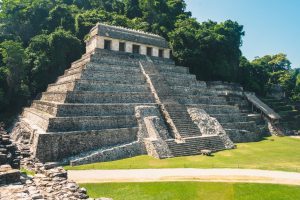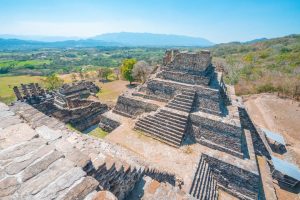
Palenque was a pre-Hispanic city that was home to the most important ceremonial center of the Maya civilization. Today, it is one of Mexico’s 67 national parks and one of the country’s most visited archaeological sites. Internationally, it has also been designated a UNESCO World Heritage Site.
The archaeological site of Palenque, in the state of Chiapas, is one of the most exceptional sites from the Classic period in the region, famous for its exceptional and well-preserved architectural and sculptural remains.
The elegance and craftsmanship of the construction, as well as the delicacy of the carved reliefs depicting Mayan mythology, bear witness to the creative genius of this civilization. Does this pique your curiosity, too? Do you want to learn everything about the history of the magnificent Mayan city of Palenque? This comprehensive feature tells you absolutely everything.
Although the city of Palenque is modern and unremarkable, the Mayan ruins are the ideal starting point for exploring Chiapas during your vacation in Mexico’s most beautiful state.
Palenque means “surrounded by trees.” In fact, the site is located on the edge of the jungle and at the foot of the mountains of Chiapas, and very dense vegetation completely surrounds the entire site. Palenque is a site particularly rich in ornamentation, featuring numerous carved stone panels and stucco sculptures of a quality unmatched in the Mayan world, which are surprisingly well-preserved despite their fragility.
The part open to the public is basically divided into four areas, and, incredible as it may seem, it accounts for only 2% of this great Mayan city; the remaining 98% remains unexplored, buried beneath the jungle.
Since they’re so close together, you can visit this archaeological site and the Roberto Barrios waterfalls on the same day.
What to Do at the Mayan Ruins of Palenque?
The Mayan city of Palenque, home to ancient relics and numerous archaeological sites that hold incredible secrets—such as temples and pyramids—is located in the northern part of the magnificent state of Chiapas. Although it is smaller than other Mayan cities such as Copán or Tikal, thanks to its cultural and architectural richness, Palenque is every bit as impressive.
In addition, this magnificent Mayan city was designated a National Park (in 1981) and has been inscribed on the UNESCO World Heritage List (since 1987). The history of the Mayan city of Palenque, in Mexico, thus sparks the interest of numerous historians and archaeologists.
This city was founded by the Maya around 100 B.C. (the Preclassic Period) and was called Lakam Ha, which means “Great Waters” because of its springs, waterfalls, and abundant rainfall, all of which contributed to the land’s fertility for agriculture. However, the city as such emerged in the 5th century during the reign of K’uk’ B’alam I (who died in 435), who, according to certain inscriptions, was the first Maya lord and the founder of Maya civilization.
During the Early Classic period, the Maya civilization experienced population growth, which led to better urban organization. The B’akaal region then became the capital of the emerging city. B’akaal occupies a central place in the history of the Mayan city of Palenque. Between the 5th and 9th centuries, there was a succession of wars, alliances, and catastrophes, but also moments of glory—all with the goal of ruling B’akaal.
Upon the death of K’uk’ B’alam I, the throne passed to Casper (August 8, 422 – c. 487), who came to power at the age of 13 and reigned for 56 years. After him, two others succeeded to the throne before K’an Joy Chitam I (490–February 465), the fourth Ayam (title of the Maya king), came to power, thus ending a four-year interregnum.
The Ayam who had the greatest impact on Mayan civilization was, without a doubt, K’inich Janaab’ Pakal I (March 603 – August 683), better known as Pakal II or Pakal the Great. He was the most famous ruler of the Mayan city of Palenque. Upon coming to power at the age of 12, he succeeded in restoring Palenque’s hegemony, which had suffered several catastrophes following battles with Calakmul (another very powerful Mayan city). Pascal II was the driving force behind several archaeological constructions, such as the Temple of the Inscriptions, which served as his own funerary monument.
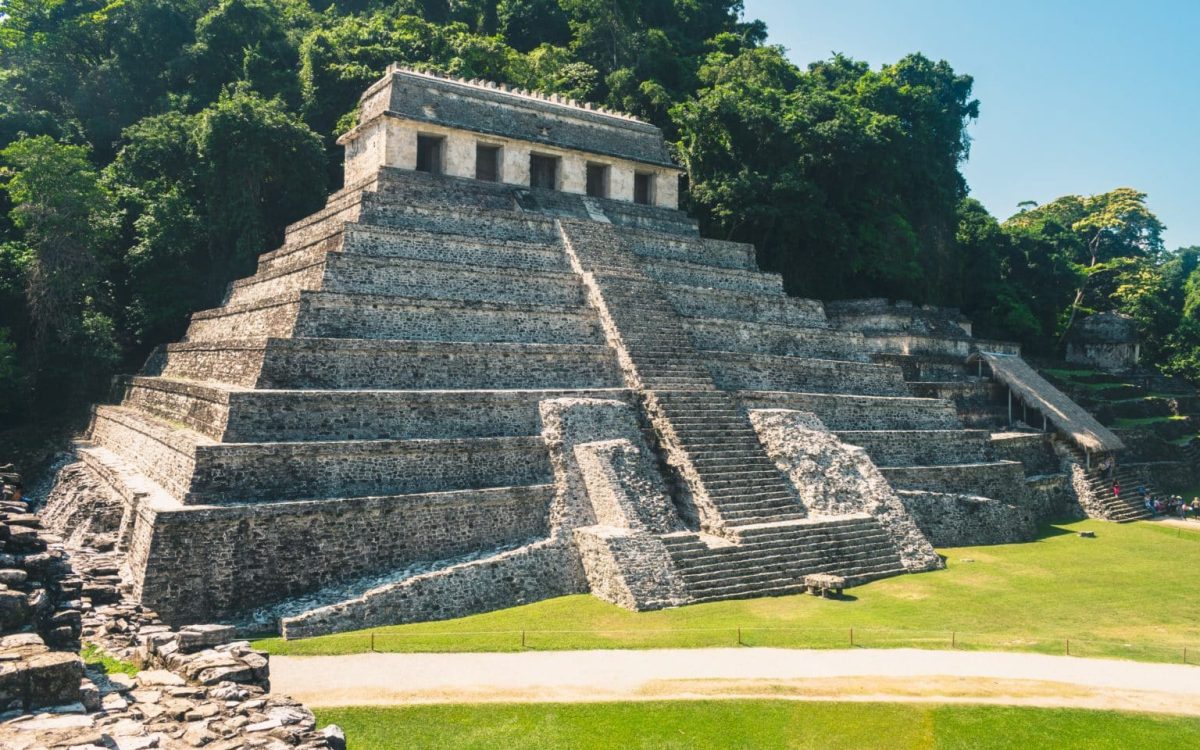
In fact, the Temple of the Inscriptions was built by K’inich Janaab’ Pakal I to serve as his funerary monument, and was completed by his son, K’inich Kan Bahlam II. This temple contains three inscribed stelae that, when joined together, form a single text of 617 blocks of glyphs that tell the history of Palenque.
In 1567, Friar Pedro Lorenzo de la Nada named this town Palenque, after it had been abandoned during the conquest of Mexico in the 16th century, which marked the fall of the Aztec Empire.
Discovering the Tomb of Pakal and the Red Queen
The first area you visit is perhaps the most interesting, since the largest pyramid contained the tomb of King Pakal, the most important ruler of this city and of the entire Maya civilization during his reign. It is said that this tomb is even more complex than the pyramids of Egypt.
A large quantity of jewelry was found in the sarcophagus of King K’inich Janaab’ Pakal I, including the famous jade mask, which is currently on display at the Museum of Anthropology in Mexico City. This tomb is no longer open to the public, but there is a replica at the site’s museum and at the Jade Museum in San Cristóbal de las Casas.
Next to King Pakal’s tomb is the tomb of his wife, the famous Red Queen, so named because her sarcophagus was painted entirely red. You can visit this tomb without any problem.
The third pyramid is the Temple of the Skull, where human sacrifices are believed to have taken place.
Visit to the Old Palace (El Palacio)
The next area is known as the Palace or the House of the Nobles. In fact, it is a platform measuring 100 m by 80 m and 10 m high, on which a complex of “houses” was built where Pakal and the nobility lived.
With its trapezoidal shape, it is the most imposing structure in the city and is located north of the Temple of the Inscriptions. Most of it was built during the reign of K’inich Janaab’ Pakal I and contains several depictions of Pakal II and his mother, Lady Sak K’uk. Begun under Pakal’s orders, construction lasted more than a hundred years, with successive expansions and renovations.
Archaeologists disagree on its function: while some, as its name suggests, consider it a residential complex, others believe it is more likely an administrative complex or a complex of buildings used for ceremonial purposes.
A highlight of this complex is the astronomical tower, which demonstrates that the Maya were highly advanced in astronomy—so much so that they were already familiar with the concept of the solar calendar long before the Europeans.
It was also discovered here that, throughout their centuries of history in Mexico, the Maya did not constitute a unified civilization; rather, there were allies and enemies even among the cities themselves. Palenque was always at war with Toniná and Calakmul, and its main allies were Tikal and Yaxchilán.
In fact, it is believed that one of Pakal’s sons died while imprisoned in Toniná.
A Tour of the Churches of the “Conjunto de las Cruces”
The next area, known as the Conjunto de las Cruces, is a square that contains three very important temples: the Temple of the Sun, the Temple of the Cross, and the Temple of the Cross Follada. You can climb up to all three temples, and at the top of each one you’ll find original engravings to discover.
The Temple of the Cross, the Temple of the Sun, and the Temple of the Foliated Cross: these three temples, which make up the “Cross” complex and are located southeast of the Palace, have a layout similar to that of the temples at the Preclassic-era Mayan archaeological site of El Mirador.
Built during the reign of Chan Balam II between the year 683 (the year of his father Pakal’s death) and 692, they recount a cosmic journey in three “stages.”
The inscriptions on these temples form a coherent whole and follow a well-defined chronological order: the text begins at the Temple of the Cross, continues at the Temple of the Sun, and ends at the Temple of the Leafy Cross.
Crowned by a magnificent openwork crest, the Temple of the Cross is the most spectacular and the tallest in the complex. From the top, you have a panoramic view of the other two temples and the Palace. You’ll have to climb several steps, but it’s worth the effort. Once at the top, you can admire the bas-relief that is believed to represent the sky, the place of origin of the world and the supernatural. It’s essential to have a reproduction on hand to make out, even if only slightly, the various elements that have been worn away by the passage of time.
The Temple of the Sun is the one that has best withstood the test of time. This temple takes us “down” into the underworld, a place through which the nocturnal sun passes, symbolized by the jaguar, lord of war and sacrifice. In this building, the overall theme of the iconography revolves around the underworld and war.
The Temple of the Foliated Cross is the one in the worst condition. At the top, the final stage of the carvings depicts a rebirth of fertility in the Earth’s upper layers.
If you’re only going to visit one temple, go to the Temple of the Cross: the view of the site from there is absolutely breathtaking!
Visit to the Northern Area of Palenque
Finally, there is the North Zone, where the famous ball game is located. It is said that players were only allowed to use their knees, elbows, and hips to play. It is believed that the losers were enslaved and the winners sacrificed, which was considered an honor for them.
Beyond that, there are also other smaller temples that are just as impressive. You can still climb almost all of the buildings, and no matter where you look, everything is covered in vegetation. Archaeologists believe that this latter group was originally intended for religious purposes, but that, due to population pressure, the buildings were converted into dwellings. This is evidenced by a large number of household items, including tools for grinding corn, obsidian blades, and an oven discovered during the excavations.
If you listen closely, you can hear the howler monkeys in the Chiapas jungle.
A short walk to the museum
Take the path that branches off to the right of the North Group. Walk through the forest, passing several clusters of partially cleared ruins, including the “Bats” group (Murciélagos).
This complex was a residential complex built during the most recent period in Palenque’s history.
It consists of a large number of buildings located between the Otolum River and the Bat Creek. The buildings are constructed on low platforms, and their interiors are subdivided in various ways. They have one or two levels connected by a narrow staircase. Some rooms have tombs beneath their floors. Everyday objects have been found in this area, clearly indicating that it was a residential space.
The walk is really pleasant.
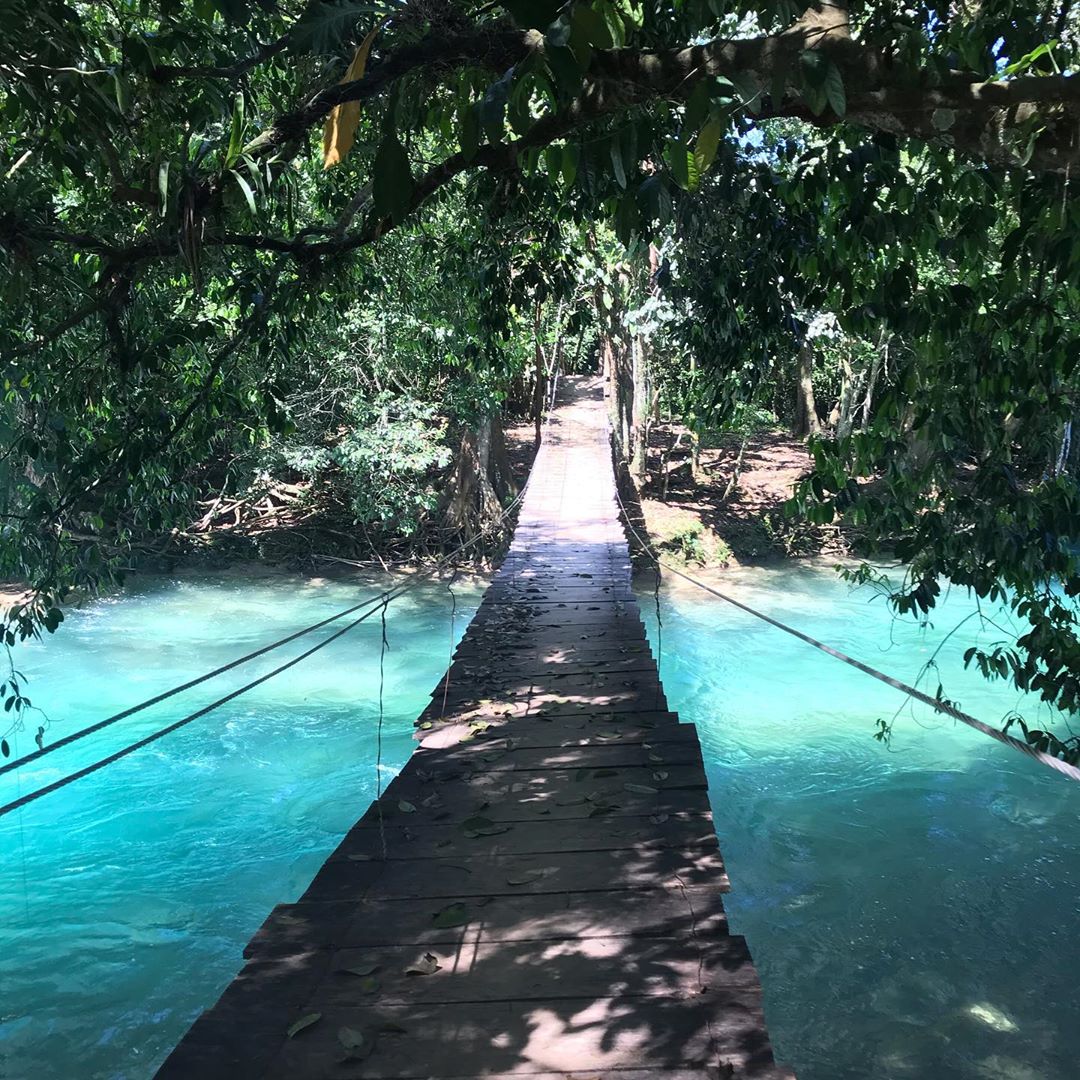
There, you can admire a beautiful waterfall on the Otolum River. The spot is known as “Baño de la Reina” (Queen’s Bath; we mention it in our lists of the best waterfalls in Chiapas), and from there the trail leads to a suspension bridge, giving the hike a delightful sense of adventure. You’ll also be able to appreciate the full force and majesty of the jungle, which is inexorably reclaiming its domain.
It’s a pleasant 20-minute walk that offers a romantic transition between the site and the museum.
Visit the museum
Admission to the museum is included in the price of the site entrance ticket and is a very interesting addition to your visit to the ruins (just like all the museums we recommend in Chiapas).
The museum houses the artifacts uncovered during various excavation campaigns: stelae and stucco bas-reliefs, panels with glyphs, jade jewelry and masks discovered in the tombs (funerary offerings), pottery, and religious objects.
Since 2007, one of the galleries has even featured a Plexiglas replica of Pakal’s burial crypt.
The museum is divided into six rooms:
– Room 1, “Welcome,” provides essential information on the historical and cultural significance of Palenque, an overview of the city’s urban characteristics, and the main periods of the site’s development. This room highlights Palenque’s importance and prestige during the Classic Period and reviews its relationships with major neighboring cities, including Calakmul, Tikal, and Tonina.
– Room 2, “South Acropolis,” features two magnificent sculptures from the 18th and 19th centuries: the explanations provided are intended to familiarize the public with the hieroglyphic narratives of the reign of K’inich Ahkal Mo’ Nahb’.
– Room 3, “Grupo de la Cruz,” showcases the religious beliefs and customs of Palenque through a collection of glyphic panels and offerings from the Grupo de la Cruz, Palenque’s ceremonial center.
– Room 4, “Death and Rebirth,” offers a glimpse into funerary practices. It contains pottery and ornaments found in burial sites. Of particular note is the collection of funerary masks, necklaces, and breastplates discovered in the tombs of the Temple of the Skull and the Temple of the Red Queen.
– Room 5, “The Palace and the Royal Court,” features magnificent monuments carved with hieroglyphic scenes and inscriptions that refer to the births, enthronements, and rituals of various rulers. The stucco sculptures depict the local elite.
-Room 6, “Housing Units,” contains figurines, sculptures, furniture, and other objects from the residential neighborhoods near the central area of Palenque, offering a glimpse into the daily lives of the city’s inhabitants.
When is the best time to visit Palenque?
High season: If you don’t like crowds, avoid long weekends or holidays, especially during Holy Week.
Best time to visit: It’s very hot all year round, but from November through February the weather is much more pleasant.
Rainy Season: Avoid traveling from June through October—that’s the rainy season in Chiapas!
How do I get there?
The site is located in the northwest of the state of Chiapas, 290 km from the capital and 200 km from San Cristóbal de las Casas. The archaeological site is 6 km from the city of Palenque, where you can find all the necessary services, such as lodging, food, and various markets.
If you’re traveling to Palenque from San Cristóbal de las Casas, the trip takes about 5 hours. Halfway between these two cities, it’s worth stopping to visit Tonina, its great pyramid, and its mysterious underground world.
📗 The roads in Chiapas are winding and mountainous, so stay alert during your trip.
- We recommend that you read our Guide to Driving in Chiapas if you decide to rent a car there.
Palenque > Mayan Ruins of Palenque
📍 The ruins of Palenque are located 10 kilometers from Palenque.
🚌 The bus ride takes about 20 minutes.
From Palenque, there are buses that depart from the Palenque market square and go directly to the entrance of the archaeological site.
Ocosingo > Mayan Ruins of Palenque
📍 The Mayan ruins of Palenque are located 125 kilometers from Ocosingo.
🚌 The bus ride takes about 3 hours and 30 minutes.
You’ll need to take one of the buses that run every 45 minutes until around midnight, bound for Palenque.
San Cristóbal de las Casas > Mayan Ruins of Palenque
📍 The Mayan ruins of Palenque are located 219 kilometers from San Cristóbal de las Casas.
🚌 The bus ride takes about 7 hours. You’ll pass through Ocosingo or Palenque before reaching the Palenque ruins.
From Ocosingo, take one of the buses that run every 45 minutes until around midnight toward Palenque.
Villahermosa > Mayan Ruins of Palenque
📍 The Mayan ruins of Palenque are located 275 kilometers from Villahermosa.
🚌 The bus ride takes about 2 hours and 30 minutes with ADO or OCC, and costs about 350 pesos per person.
Tuxtla Gutiérrez > Mayan Ruins of Palenque
📍 The Mayan ruins of Palenque are located 275 kilometers from Tuxtla Gutiérrez.
🚌 The bus ride takes about 8 hours. You’ll pass through San Cristóbal de las Casas and then through either Ocosingo or Palenque.
Mexico City > Villahermosa > Mayan Ruins of Palenque
📍 Villahermosa is located 759 kilometers from Mexico City.
✈️ A trip from CDMX (Mexico City) to Villahermosa will cost between 1,000 and 2,500 pesos per person.
Four domestic airlines operate out of Villahermosa Airport: Viva Aerobus, Interjet, Volaris, and Aeroméxico.
🚌 The bus ride takes about 2 hours and 30 minutes with ADO or OCC and costs about 350 pesos (about 20 €) per person.
Additional information about the routes
If you’re using GPS, just search for “Palenque Archaeological Site”
The road is safe, but it has many curves. It is recommended that you avoid driving at night on the roads in Chiapas.
It doesn’t always happen, but there may be roadblocks where people from local communities stretch a rope across the road to ask for money.
We recommend that you bring some coins with you.
- For more information on safety and the precautions you should take in Mexico, see our article “Is Mexico Dangerous?”
Site Map

Costs
Admission and parking
Admission to the archaeological site costs 75 pesos (approximately €3) per person
Admission to the national park costs 35 pesos (approximately €1.50) per person
Local tour guide: Between 100 and 500 pesos (between 4 and 20 euros)
Parking: 20 pesos (approximately 1 euro) per car
Guided Tour
You don’t need a guide to visit Palenque. You can do it on your own! However, you can hire a guide if you enjoy their explanations and stories. There are many options available, and you can choose the one that suits you best.
Our Tips
- If you're going away for a few days, we recommend that you don't buy a round-trip flight; it's better to fly to Villahermosa and return from Tuxtla, or vice versa.
- If you're not on a tour organized by a travel agency, the admission price does not include a guide, but you can hire one on site. They charge between 100 and 500 pesos (between 4 and 20 euros) per group.
- In our article “How to Get Internet in Mexico Without Spending a Lot,” we offer some tips on internet access in Mexico.
- Wear comfortable shoes and light clothing; even in winter, it gets very hot, and the jungle humidity makes it feel even hotter.
- Bring your own water bottle; they don't sell anything at the archaeological site, and outside, street vendors sell water at exorbitant prices.
- Be sure to apply sunscreen and wear a hat, especially if you plan to visit with your family and children. The site is large, and you'll be spending several hours in the sun.
- Some temples—or even entire groups of temples—may be temporarily closed to the public to allow for consolidation work or excavations to take place.
Accommodations
Cabins: We highly recommend staying at the cabins in the “Panchán” region; there are many options, and they’re just a short walk from the Mayan ruins. Just 2 km from the Palenque archaeological site, Cabañas Kin Balam Palenque offers comfortable rooms surrounded by lush nature and also features a swimming pool. It’s an ideal place to stay and explore the archaeological site, at a very affordable price.
Palenque: Another option is to stay in the city of Palenque. There, you’ll find guesthouses or Airbnb rooms starting at 200 pesos (approximately 8 €) per night. Here are some great options if you’d like to stay in the city of Palenque: comfortable, air-conditioned rooms with a good breakfast, located 7 km from the Palenque archaeological site but close to the bus terminal.
You can also choose to book a night at another location in Chiapas, such as:
Misol Ha: This ecotourism center is just a half-hour drive away and also offers cabins starting at 290 pesos (approximately 12 €) per night.
Agua Azul: This ecotourism center is an hour’s drive away and also offers cabins starting at 250 pesos (approximately 10 €) per night.
Bonampak: A two-and-a-half-hour drive away, in the Lacandon Jungle, there are 22 Lacandon camps, with cabins starting at 300 pesos (approximately 12 €) per night.
Where to Eat
In the “Panchán” area, there are several restaurants where you can eat very well at very affordable prices; breakfasts, featuring Mexican or international menus, cost around 50 pesos (about €2), and lunches, around 100 pesos (about €4).
- You can discover the best restaurants in Palenque by reading our article on this topic here.
We recommend that you have a hearty breakfast at the Archaeological Zone. Keep in mind that everything inside the site is very expensive; for example, a bottle of water costs 30 pesos (approximately €1.50).
So now you know almost everything about the history of Palenque, the wonderful Mayan city in Mexico. All that’s left is to book your flight and set out to discover the magnificent Mayan ruins of Palenque. Do you have any questions about visiting the Mayan ruins of Palenque? Are you planning a trip? Send us a message!