Mexican craftsmanship is one of the strongest expressions of the country’s identity: bright colors, natural materials, skills handed down from generation to generation. From the alebrijes of Oaxaca to the sarapes of Saltillo, from Huichol art to the Talavera of Puebla, each piece tells its own story.
To remember
- Mexico is one of the world’s richest countries for handicrafts, in terms of both the diversity of techniques and the quality of materials (clay, wood, textiles, precious metals, etc.).
- Each region and ethnic group has its own folk art forms: alebrijes, huipiles, huichol art, Talavera, sarapes, barro negro, etc.
- Mexican craftsmanship is an important economic sector, both for the local market and for export (United States, Europe, Australia…).
- Fonart, the National Fund for the Promotion of Crafts, has been supporting craftsmen and the marketing of their work since 1974.
- Behind each object lie local natural resources, religious symbolism, cosmogonies and family histories.
- Buying authentic crafts directly supports rural communities and artisan dynasties.
Mexican crafts, a colorful identity
Mexican art expresses itself in many ways, but it is undoubtedly through craftsmanship that it is most visible on a daily basis. Mexico is one of the world’s leading producers and exporters of handicrafts. From generation to generation, techniques are perfected, giving rise to unique, high-quality works.
On the roads, in the streets, in the markets, it’s impossible not to come across craftsmen at work: Glass, clay, textiles, precious stones, wood, paper, silver… Mexicans transform materials into objects charged with symbolism.
In Mexico, craftsmanship is not just another “souvenir”: it’s a piece of culture that you take home with you.
Arnaud Joly
Mexican handicrafts on the international scene
Alebrijes, clay pottery, silver and gold jewelry, wood carvings, jade and amber objects, sarapes, charro hats, rebozos, Puebla ceramics, piñatas… these pieces are part of Mexican folklore and are now known far beyond the country’s borders.
On the international scene, Mexican craftsmanship is highly recognized. It reflects the cultural diversity of a society made up of 62 ethnic groups, each with its own folk art forms.
The main export destinations are Australia, Germany, Canada, Colombia, Spain, the United States and Italy. Among the most exported items: silver, onyx, clay, wood, ceramics, pre-Hispanic paintings and handmade fabrics.
Wherever you are in the world, all it takes is an alebrije or a sarape to bring Mexico into the room.
Arnaud Joly
To support this sector, in 1974 the government created the Fonart (Fonds national pour la promotion de l’artisanat) to support craftsmen, coordinate public policies and facilitate the marketing of their work.
The most representative pieces of Mexican craftsmanship
Magnificent, atypical, warm and attractive, Mexican handicrafts plunge you into an intoxicating universe. Here’s a roundup of emblematic pieces to know (and bring back).
Alebrijes: fantastic creatures from Oaxaca
Alebrijes can be found all over Mexico, but are native to
San Martín Tilcajete and San Antonio Arrazola, in the state of Oaxaca. They are imaginary creatures fusing several animals, painted in intense colors.Originally, craftsman Pedro Linares made them from cardboard, before other artisans adopted wood to make them more resistant. In Oaxaca, you can visit many workshops and observe the entire the entire manufacturing process.
Alebrijes are what happens when the imagination decides to break all the rules… and so much the better.
Arnaud Joly
Huipiles: the symbolic garment of indigenous women
The huipil is a traditional garment from Central America and Mexico, particularly present in Yucatán. It is a kind of chasuble worn by women of all social classes.
The huipiles are adorned with shimmering embroidery, the motifs of which vary from village to village. In Oaxaca, Chiapas, Guerrero, Veracruz, Puebla, Yucatán, Michoacán or Quintana Roo, this garment symbolizes the woman’s role in society and embodies beliefs, history and religious identity.
A huipil is more than just a garment: it’s an embroidered story, worn on a daily basis.
Arnaud Joly
Huichol art: visions, colors and cosmogony
Huichol art can be recognized by its painted boards(nierikas) and pearl-covered figurines (chaquira). These motifs are often said to be inspired by ritual visions linked to the consumption of peyote.
The Huichols live mainly in mountainous areas north of Jalisco and in large parts of Nayarit. Their population is estimated at around 50,000. They are among the groups that have best preserved their culture since the Spanish conquest.
Their religion is based on a symbolic trinity: peyote, deer and corn, closely linked to their myths, ceremonies and worldview. Huichol art began as a ritual art form, and has since been exported and appreciated the world over.
Types of Huichol art
The main expressions are :
- Thread paintings, made on wax-covered wooden boards, where the thread forms symbolic motifs.
- Beaded pieces(chaquira), which cover objects (masks, skulls, turtles, violins, etc.).
Some objects are created for commercial use, others reflect religious experiences and shamanic visions. Modern materials (glass beads, commercial pigments) have gradually replaced ancient materials (stone, vegetable dyes, clay), without eliminating their symbolic charge.
Huichol art is like looking at a dream fixed in matter: the more you look, the more worlds you discover.
Arnaud Joly
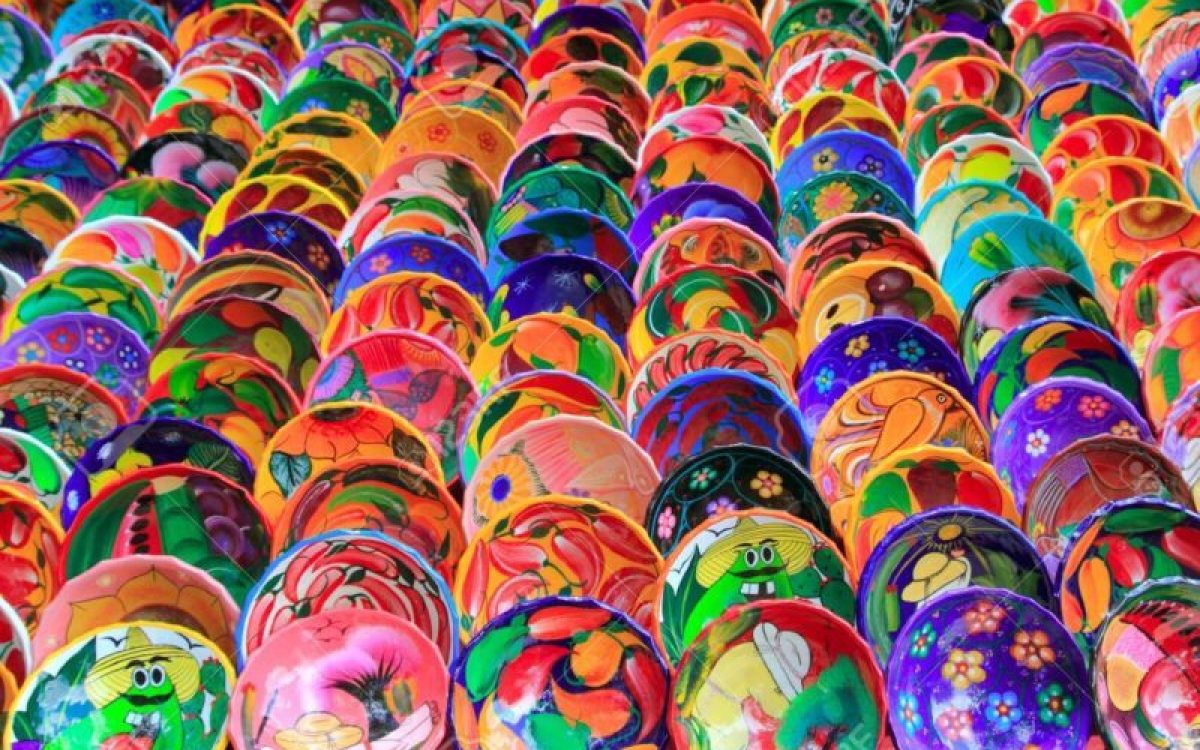
Talavera poblana: blue and white ceramics from Puebla
Originating in Puebla de Zaragoza, Talavera poblana is a glazed pottery inspired by inspired by Talavera de la Reina (Toledo, Spain). Its characteristic blue and refined motifs have made it one of Mexico’s best-known crafts.
Production dates back to the late 16th century. In the 17th century, guilds established rules and quality controls. Today, a designation of origin protects genuine Talavera de Puebla.
Sarapes: warm, graphic weavings
Sarape is a traditional textile that originated in the state of Tlaxcala in the 18th century, It was later popularized in the north of the country, notably in Saltillo (Coahuila), which became the main producer.
Made from wool or cotton, sarapes are spun by hand on wooden looms. The hand-embroidered diamond is the hallmark of an authentic sarape.
Today, sarape extends beyond Mexico’s borders and can be found in international fashion, as a garment, blanket or decorative element.
Trees of life: narrative ceramics from Metepec
Pottery is one of Mexico’s oldest arts, present in countless forms. Among the most emblematic pieces are ceramic trees of life, which appeared around 100 years ago in Metepec (Mexico State).
Inspired by biblical trees (Adam and Eve), they can recount religious scenes, biographical stories or historical episodes. They can be “read” from bottom to top.
Painted or left in the natural color of clay, these trees embody the axis of the universe and of life. Flowers, animals, characters, suns, moons, calacas… a whole world unfolds on a single piece.
A tree of life is a 3D storybook: each detail is a chapter that the eye enjoys rereading.
Arnaud Joly
Mexican lacquer from Chiapas
Mexican lacquerware from Chiapa de Corzo (Chiapas) is one of the country’s oldest crafts, with no direct link to Asian lacquer.
Craftsmen mix chia seed oil, animal fat and mineral powder to create protective and decorative coatings, giving objects a smooth, shiny appearance.
Wool carpets from Teotitlán del Valle
In Teotitlán del Valle (Oaxaca), wool carpets are hand-woven on treadle looms. The wool is pre-washed, carded, hand-spun and dyed with natural pigments: cochineal for reds, indigo for blues, huizache or walnut for browns, moss and flowers (such as cempasúchil) for yellows.
Each color requires nearly a week of preparation. Patterns can be geometric or inspired by paintings, reproduced on the loom with impressive precision.
Atzompa terracotta, barro negro and glazed pottery
Mexican pottery – rolled, molded, low-fired – comes in an infinite variety of styles. Many villages specialize in a particular type of pottery, sometimes produced by entire families.
Barro negro de San Bartolo Coyotepec
The famous barro negro (black clay) of San Bartolo Coyotepec (Oaxaca) owes much to Doña Rosa, who, in the 1950s, succeeded in giving these pieces a soft, shiny finish by playing with the atmosphere of the kiln and polishing.
Atzompa glazed pottery
In Santa María Atzompa (Oaxaca), glazed pottery is the mainstay of the local population. These pieces, often used for cooking, can be recognized by their jade-green color, due to the traditional lead monoxide glaze.
Handmade toys, hats and metalworking
Handmade toys
You can still find many handmade toys on the market: spinning tops, pirinolas, rattles, lotteries, wooden cars, dolls with multicolored braids and the famous “negrita merecumbé”.
Charro hats
Charro hats, emblematic of the Mexican imagination, are made from rabbit skin, ironed and embroidered by hand. Once a status symbol for the country’s wealthy landowners, they also provide protection from the sun on horseback.
Metalworking
Thanks to its mineral wealth, Mexico has developed an important metalworking industry (gold, silver, jadeite, amber…). In towns such as Taxco (Guerrero) and certain regions of Hidalgo, goldsmiths create high-quality silver rings, pendants and earrings.
From wooden toys to silver jewelry, Mexican craftsmanship accompanies daily life from the first laugh to the most beautiful gift.
Arnaud Joly
Summary of Mexican handicrafts
| Type of craft | Main region | Material / technique |
|---|---|---|
| Alebrijes | San Martín Tilcajete, San Antonio Arrazola (Oaxaca) | Carved and painted wood, fantastic creatures |
| Huipiles | Yucatán, Oaxaca, Chiapas, Guerrero, Puebla… | Embroidered textiles, traditional women’s clothing |
| Huichol art | Nayarit, northern Jalisco, Zacatecas | Thread paintings, beads (chaquira) on objects |
| Talavera poblana | Puebla de Zaragoza | Blue and white glazed ceramics, designation of origin |
| Sarapes | Tlaxcala, Saltillo (Coahuila) | Wool or cotton weaving, geometric motifs |
| Trees of life | Metepec (Mexico State) | Carved and painted ceramics, symbolic scenes |
| Barro negro | San Bartolo Coyotepec (Oaxaca) | Polished black clay, fired in reduced atmosphere |
| Atzompa pottery | Santa María Atzompa (Oaxaca) | Jade-green glazed pottery, culinary use |
| Teotitlán carpet | Teotitlán del Valle (Oaxaca) | Wool weaving, natural dyes |
| Silver jewelry | Taxco (Guerrero), Hidalgo | Silver jewelry, rings, pendants, earrings |
FAQ – Handicrafts from Mexico
Where to buy authentic Mexican handicrafts?
The safest way is to visit local markets, artisans’ workshops or certified stores. In some regions, cooperatives run by the communities themselves guarantee authenticity and fairer remuneration.
How to recognize a quality handcrafted object?
Look at the finish (painting, stitching, weaving), the type of material (natural or not) and the consistency of the price. A finely detailed alebrije or an entirely hand-woven carpet cannot be sold for the same price as an industrial souvenir.
Can you ship handicrafts from Mexico?
Yes, many stores offer international shipping, especially for rugs, pottery and jewelry. However, you’ll need to take into account shipping costs, delivery times and possible customs taxes.
Are certain crafts protected by an appellation?
Yes, such as Talavera de Puebla, which has an appellation of origin. Other products are governed by quality standards or regional labels.
Does buying handicrafts really help local communities?
When you buy directly from artisans, their families or cooperatives, the impact is real, the impact is real: income stays in the local community, enabling know-how to be passed on to future generations.
A country that tells its story through its artisans
Mexican craftsmanship is much more than a collection of decorative objects: it’s a living memory, a local economy, a unique aesthetic and a direct link with people and territories. Behind each piece, there are hands, stories and entire worlds to discover.
When it comes down to it, bringing back handicrafts from Mexico isn’t about filling a suitcase: it’s about prolonging the journey at home.
Arnaud Joly