The Aztecs and Mayans developed sophisticated calendar systems. Yet we often confuse the famous “Sun Stone” with a calendar, or ignore the place of the Long Count among the Mayans. Here are the essentials for sorting out what’s real and what’s not.
Things to remember
- The “Sun Stone” is not a practical calendar but a cosmological monument.
- The Aztecs and Mayans used two overlapping cycles: 260 sacred days and 365 solar days.
- The 52-year cycle(Calendar Round) is celebrated by the Aztecs with the Festival of the New Fire.
- Only the Maya used a Long Count to measure millennia.
Myths & Realities
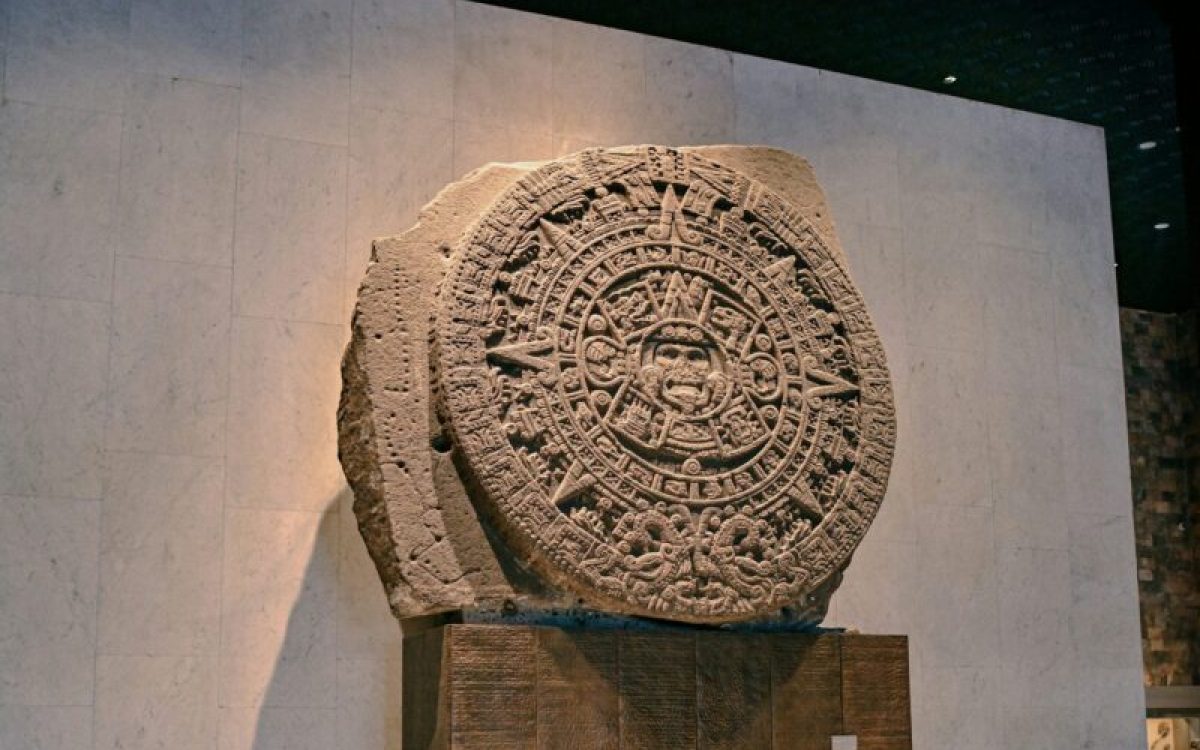
Mesoamerican calendar systems are often confused, simplified or even romanticized. The greatest confusion arises from the famous “Sun Stone” on display in Mexico City: although its iconography incorporates calendrical elements, it was not used as a daily diary. It is above all a cosmological work, intended to represent the successive eras and the central role of the sun in world order.
Another common misconception is that Mayans and Aztecs shared exactly the same calendar. In reality, they had two similar cycles – one of 260 days (sacred) and one of 365 days (solar) – but with names, glyphs and rituals specific to each civilization. This resemblance reflects a regional cultural kinship rather than a perfect identity of systems.
The 52-year cycle is also said to belong solely to the Maya. However, this cycle of readjustment between 260 and 365 days is known to both traditions. Among the Aztecs, its closing was marked by the spectacular Festival of the New Fire, a ritual of cosmic renewal in which all fireplaces were relit.
Finally, there’s another special feature: the Long Count. This system, used only by the Mayans, enabled events to be dated over millennia, thanks to a complex vigesimal calculation. The Aztecs, for their part, did not develop an equivalent Long Count: their conception of time remained centred on cycles and their ritual of renewal.
These nuances show that calendars were not simply practical tools, but symbolic structures, linking the cosmos, politics and everyday life. Among Mesoamerican peoples, time was lived as much as it was counted.
Mythology and cosmogony around Aztec time
To grasp the logic of time among the Aztecs, we recall the mythology of the “Five Suns”. The universe is born ofOmeteotl, the primordial divinity of duality, who is divided into Ometecuhtli (masculine principle) and Omecihuatl (feminine principle). From this couple derive four powers linked to directions: Quetzalcoatl (West), Huitzilopochtli (South), Xipe Totec (East) and Tezcatlipoca (North).
These forces structure the ages of the world (“suns”) and irrigate the symbolism of days and years: time is not linear but cyclical, interwoven with cardinal points, gods and rituals.
How calendars work
The sacred cycle (260 days)
Aztec: Tonalpohualli = 20 day signs × 13 numbers = 260 days.
Maya: Tzolk’in = 20 names of days × 13 numbers = 260 days.
Each day/number combination carries a ritual value (divination, omens, choice of auspicious dates).
The solar cycle (365 days)
Aztec: Xiuhpohualli = 18 “months” of 20 days + 5 additional days(nemontemi) considered harmful = 365 days.
Maya: Haab’ = 18 “months” of 20 days + 5 additional days(Wayeb’)= 365 days.
Interlacing (~52 years)
The 260×365 interaction produces a grand cycle of around 18,980 days (~52 solar years). Among the Aztecs, its closure was celebrated by the Festival of the New Fire.
The “Long Count” (specific to the Maya)
The Maya use a long count (modified vigesimal basis: baktun, katun, tun, etc.) to record events over very long durations – a historical dimension absent from the Aztecs on a comparable scale.
Aztec vs. Mayan comparative table
| Aspect | Aztec | Maya |
|---|---|---|
| Sacred calendar (260 days) | Tonalpohualli (20 signs × 13) | Tzolk’in (20 names × 13) |
| Solar calendar (365 days) | Xiuhpohualli = 18×20 + 5 nemontemi | Haab’ = 18×20 + 5 Wayeb’ |
| Great cycle (~52 years) | Ends with the Festival of New Fire | Pairing Tzolk’in + Haab’ (Calendar Round) |
| Long count | No equivalent attested | Yes(baktun, katun, tun…) |
| Iconic support | “Sun Stone” (cosmological monument) | Stelae/codex with dates in glyphs (often in Long Count) |
| Link between gods & directions | 4 powers/directions structure days & years | Local ritual associations (e.g. Venus, regional deities) |
| Uses | Ritual, divinatory, agricultural, political | Ritual, divinatory, agricultural, historical (long dating) |
What do these “calendars” look like?
On the Aztec side, the “Stone of the Sun” concentrates cosmic symbols: central face (often interpreted as Tonatiuh), rings of day signs, markers of eras. It is primarily ritualo-cosmological rather than a “diary”.
On the Maya side, dates appear in glyphs on stelae, lintels and codices, combining Tzolk’in, Haab’ and sometimes Long Count.
Rituals & customs
Among the Aztecs, each day and each year is “carried” by a deity. The 5 additional days(nemontemi) are considered unsuitable for major undertakings. The end of the great cycle (~52 years) – when 260 and 365 resynchronize – marks the Festival of the New Fire.
Among the Maya, day-counting priests interpret the combinations of the Tzolk’in. The Long Count inscribes political, dynastic and cosmological events into a remarkable temporal depth.
FAQ
Did December 21, 2012 really herald the end of the world?
No. The date simply marked the end of a major Mayan Long Count cycle (13 baktun), a bit like the passing of a millennium in our Gregorian calendar. It was a symbolic renewal, not an apocalyptic prophecy.
What’s the difference between the Aztec and Mayan calendars?
Both civilizations used a 260-day sacred calendar and a 365-day solar calendar, but with different names, glyphs and rituals. The Maya were distinguished above all by their Long Count, enabling events to be dated over millennia.
What were these calendars used for in everyday life?
They had a dual function: to organize agricultural and political life (sowing, harvesting, festivals, reigns) and as divinatory aids (choosing the right date for a wedding, war or religious ceremony).
Why did the Aztecs consider certain days “evil”?
In the Aztec solar calendar, the last 5 days of the year(nemontemi) were considered dangerous and unproductive. Important decisions were avoided, as these days were associated with cosmic instability.
Can we still see these calendars today?
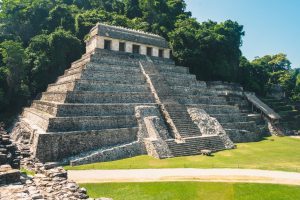
Yes. The “Sun Stone” is on display at Mexico City’s National Museum of Anthropology. Mayan stelae and inscriptions can be seen at numerous archaeological sites such as Palenque, Copán and Tikal. These testimonies still allow us to admire the precision of their time systems.
“In Chiapas, time isn’t just a series of days: it’s the breathing of the world, where the sacred, agriculture and history beat to the same rhythm.
To find out more
Mesoamerican calendars are not simply instruments for measuring time, they reflect a vision of the world in which human history, the divine and nature are intertwined. To find out more, you can :
- Visit Mexico City’s National Museum of Anthropology to admire the “Sun Stone”.
- Explore Mayan sites such as Palenque, Copán and Tikal, where you’ll find numerous calendrical inscriptions.
- Read codexes and specialized studies to discover the interpretation of glyphs and sacred cycles.
What fascinates you most about these temporal systems? Feel free to share your impressions in comments.